

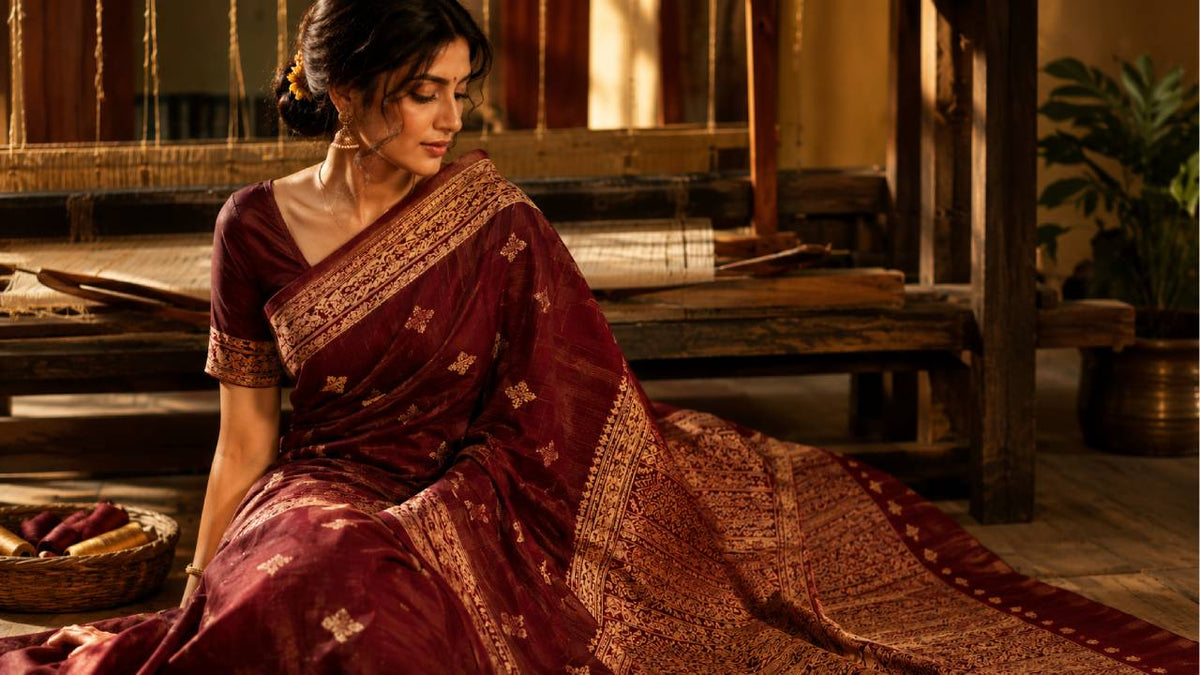
Ask any saree connoisseur where India's finest cotton sarees come from, and Bengal tops the list. From the gossamer-light mul cotton sarees of Shantipur to the intricately woven dhakai jamdani, West Bengal's handloom tradition has earned a reputation spanning centuries. What makes it so special? Here's the history, craftsmanship, and geography behind the legacy.
A Legacy Rooted in the Ganges Delta
Bengal's fame for cotton weaving isn't accidental - it's geographical. The fertile plains along the Ganges and Padma river basins were historically ideal for growing fine, long-staple cotton. Weaving clusters in Shantipur, Phulia, Dhaniakhali, and Murshidabad developed generations of specialized skill passed down through families, turning weaving into both livelihood and art. This ecosystem of farmers, spinners, and weavers is why the region still produces some of the finest handloom sarees in the country today.
The Magic of Mul Cotton
Mul cotton (short for "malmal") is prized for its fine yarn count, breathability, and soft drape, ideal for India's hot, humid climate. Unlike mass-produced fabrics, authentic mul cotton is handwoven from yarn that's often hand-spun or fine-combed, resulting in fabric so light it's called "woven air." It's the same textile once favored by Mughal royalty and later prized in colonial-era trade as one of Bengal's top exports. New to the fabric? Our guide to pure mul cotton sarees covers what to look for when buying authentic pieces.
Dhakai and Jamdani: Weaving as Poetry
No conversation about Bengal cotton is complete without dhakai jamdani, a technique where intricate motifs are hand-woven directly into the fabric using discontinuous weft threads, rather than printed on afterward. This labor-intensive craft, recognized by UNESCO as an Intangible Cultural Heritage, can take weeks per saree. The result: motifs that appear to float on the surface, a hallmark of genuine dhakai mul cotton sarees. Explore our dhakai mul cotton collection to see this artistry up close.
GI Tags: Protecting Authenticity
Several Bengal handloom traditions - including Shantipuri and Dhaniakhali sarees - carry Geographical Indication (GI) tags, legal recognition tying a product's identity to its region and traditional production method. GI tagging certifies that a piece is genuinely handwoven in Bengal, not a power-loom imitation, and protects the livelihoods of artisan families who depend on this craft.
Sustainability and the Handloom Revival
Bengal cotton sarees are seeing renewed popularity, driven by growing interest in sustainable fashion and slow textiles. Handloom weaving uses no electricity, produces minimal waste, and supports rural artisan economies directly - a sharp contrast to fast fashion's footprint. For eco-conscious shoppers, an eco-certified handwoven saree is a small but meaningful step toward ethical, low-impact fashion. Our eco-certified handloom sarees collection is built around this philosophy.
Festivals, Heritage, and Everyday Elegance
From Durga Puja to Poila Boishakh, cotton sarees are woven into the cultural fabric, quite literally, of Bengali life. Their comfort suits daily wear, while intricate borders and pallu work make them festive-ready. This dual identity is part of why Bengal cotton sarees have become a pan-India favorite.
Choosing an Authentic Bengal Cotton Saree
When shopping for a genuine handloom piece, look for:
- GI-tagged or artisan-verified sourcing
- Hand-spun or fine-combed mul cotton yarn
- Visible handwoven texture rather than uniform machine finish
- Natural, breathable fall rather than a stiff, starched drape
Buying from brands with transparent artisan sourcing, like our pure and dhakai mul cotton collections, ensures your purchase supports the weavers keeping this centuries-old craft alive.
The Bottom Line
Bengal's fame for cotton sarees isn't just about fabric, it's a living tradition shaped by geography, generational craftsmanship, and an eye for detail. Whether you're drawn to mul cotton's feather-light drape or dhakai jamdani's storytelling motifs, every Bengal handloom saree carries centuries of heritage, woven thread by thread.
Ready to add an authentic piece to your wardrobe? Browse our full range of handloom cotton sarees and discover the story behind every weave.

